

High-cube warehouses and distribution centers are built for scale, speed, and uptime. Taller storage, denser racking, automated fulfillment, and larger fire sprinkler zones all increase the risk of consequences if a fire protection system fails. Yet many facilities still treat sprinkler pipe corrosion and failures the same way they’ve done for decades: wait for leaks, replace the damaged pipe, and move on.
That approach may seem practical in the moment, but it often fails to treat the hidden cause. If oxygen, trapped water, and steel remain in contact inside the piping, corrosion will continue, and it’s only a matter of time before leaks occur.
For owners, managers, contractors, and engineers, the question is not simply, “Which pipe should we replace?” The better question is, “what is actually causing the pipe failures, and how do we prevent this from happening altogether?”
Pipe Replacement Mends the Leak, Not the Root Cause of the Failure
When a pinhole leak appears in a sprinkler system, replacing that section of pipe seems like the obvious solution. Immediate water damage and loss are limited, the system is restored, and operations get back to normal. But corrosion is rarely isolated to the one piece of pipe that was replaced.
In dry and preaction systems, compressed air introduces oxygen into the piping, while residual water remains after system trips, tests, condensation, or incomplete draining. Wherever oxygen and moisture meet steel, corrosion persists. NFPA standards and FM Global guidance have long recognized that fire sprinkler piping containing air corrodes dramatically faster than piping protected with nitrogen.
When you rely solely on customary pipe replacement:
- The leak may be repaired, but oxygen remains in the system.
- The new pipe may be connected to already compromised piping.
- The facility resumes operation with the same risk profile.
In other words, customary pipe replacement alone creates a false sense of security. The system may look repaired from the outside while continuing to deteriorate internally.
The Cost of Corrosion is Amplified in High-Cube Facilities
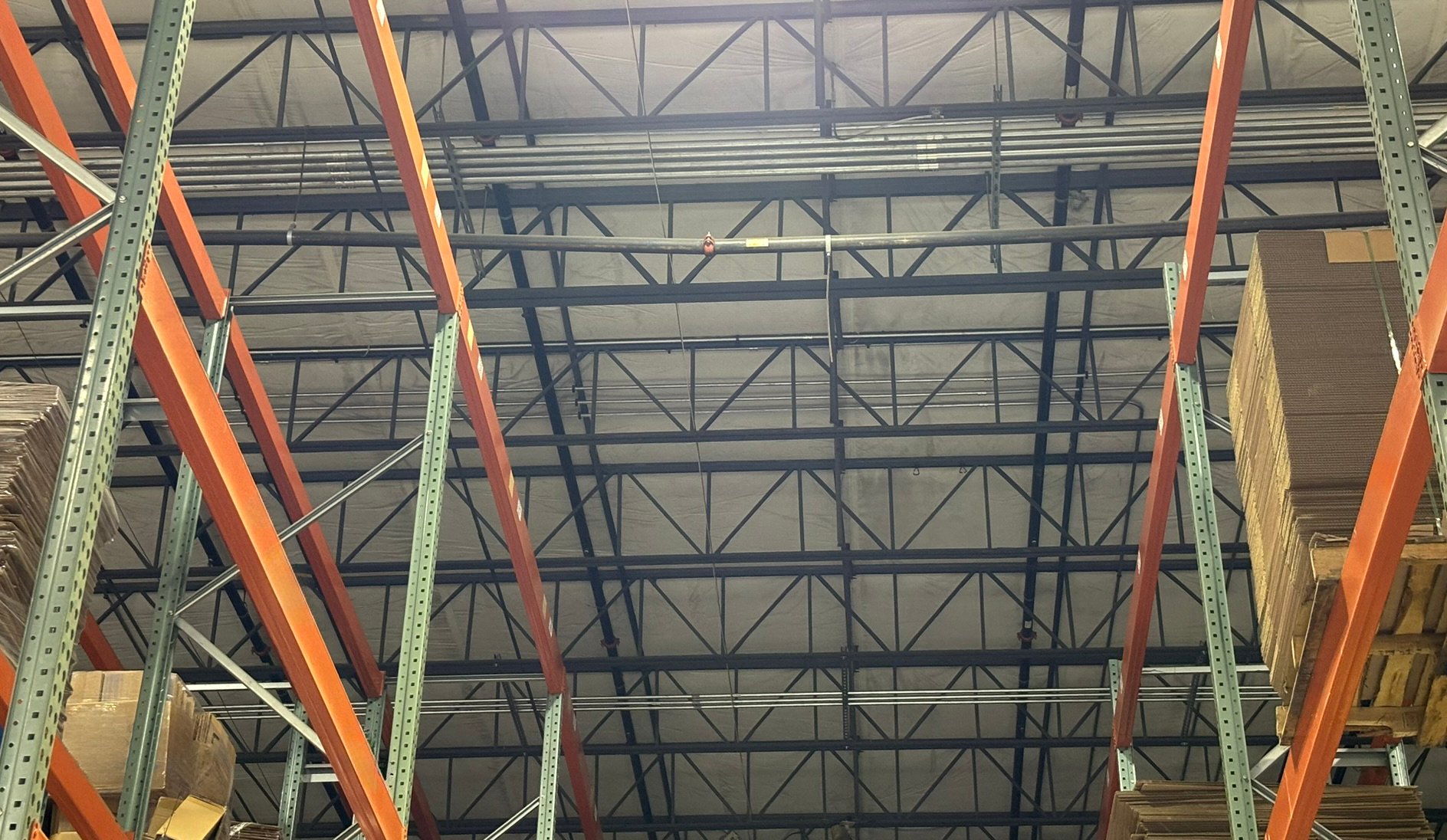
Corrosion is costly in any fire sprinkler system, but in high-cube facilities those costs are magnified. These buildings protect large storage volumes, high-value inventory, complex rack configurations, and business-critical fulfillment operations. A single leak can damage inventory, ruin equipment, disrupt operations and shipping schedules, compromise insurance compliance, and break customer commitments.
The impact to an owner is not limited to the direct cost for the pipe repair. Pipe replacement in a high-cube environment often requires lift access, inventory relocation, shutdown coordination, loss prevention planning, and repeated contractor visits. What looks like a localized repair can quickly become a facility-wide operational disruption.
Unchecked corrosion leads to:
- Water damage to stored goods and packaging
- Interruption to pick, pack, and ship operations
- Emergency service premiums and after-hours labor
- Fire watch or impairment management requirements
For facilities built around throughput and uptime, repeated pipe replacement is not a maintenance strategy; it’s a recurring operational risk.
The Hidden Cost: Hydraulic Performance Degrades Over Time
The most visible corrosion problem is a leak, but the more dangerous problem may be what happens before and beyond the leak. Internal corrosion can roughen pipe walls, create deposits, restrict flow paths, and change how the system performs hydraulically.
The internal deterioration results in:
- Reduced internal pipe diameter
- Higher friction loss
- Obstructions at fittings, branch lines, and low points
- Unreliable flow assumptions during a fire event
In high-cube storage, sprinkler performance is tightly linked to the commodities, storage height, ceiling height, rack configuration, and water supply assumptions used in the original design. If corrosion changes the interior condition of the piping, the system may no longer behave as the system was designed and installed to perform.
The Safest Fix Starts with Assessment, Not Assumption
A safer path begins with understanding actual system conditions. Before replacing large amounts of pipe, facilities should evaluate where corrosion is occurring, how advanced it is, and whether failures are isolated or part of a broader pattern.
This approach moves the facility away from ongoing, reactive repairs toward informed risk reduction. It also helps contractors and owners focus capital where it delivers the highest value. A practical corrosion management plan should include:
- A comprehensive pipe condition assessment and targeted investigation
- Identification of trapped water locations and high-risk zones
- Selective pipe replacement where deterioration is confirmed
- A long-term strategy to control oxygen exposure inside the system
Nitrogen Inerting Changes the Environment Inside the Pipe
Once deteriorated pipe is identified and repaired, the next step is to prevent the same conditions from repeating. Nitrogen inerting does this by replacing oxygen with high-purity nitrogen in dry and preaction sprinkler systems, removing the primary driver of internal corrosion.
With nitrogen inerting, high-cube facilities can:
- Reduce oxygen-driven corrosion in dry and preaction systems
- Extend the useful life of both new and existing sprinkler piping
- Reduce recurring leak repair and emergency service costs
- Improve confidence in long-term hydraulic performance
- Protect inventory, uptime, and business continuity
For new construction, nitrogen can be incorporated into the original system strategy. For existing facilities, it can be deployed as part of a retrofit after assessment, targeted repair, and proper commissioning.
Partner With ECS Before the Next Leak Becomes the Next Shutdown
ECS helps owners, facility managers, contractors, and engineers move beyond temporary repairs and build corrosion management strategies that match the risk profile of high-cube facilities. From pipe condition assessment and technical guidance to nitrogen inerting solutions and long-term support, ECS provides the tools and expertise needed to extend your system’s life and ensure its reliability.
Ready to stop replacing the same problem over and over? Contact ECS to evaluate your needs and build a practical plan to reduce corrosion risk before it disrupts your operation.