 The Physics and Economics of Sprinkler Pipe Decay Across All System Types
The Chemistry Behind the Capital Drain
Internal corrosion requires a combination of steel, moisture, and oxygen. Oxygen supports the electrochemical reaction that converts the pipe’s internal metal surface into corrosion products. Remove or materially reduce one of those conditions, and the reaction becomes far less aggressive.
The source and behavior of oxygen differ by system type. Wet systems generally begin with a finite amount of oxygen, but that oxygen can still create concentrated corrosion zones where air remains trapped. Dry and preaction systems face a more continuous exposure because a standard compressor repeatedly introduces ambient air into the piping network. Ambient air contains approximately 21% oxygen, along with moisture that can condense inside the system. Every pressure-maintenance cycle can replenish the environment that supports accelerated corrosion.
Wet systems are not automatically protected from internal degradation. Air can remain trapped at high points and along branch lines. Where an oxygen pocket meets water and the pipe wall, localized corrosion can develop. Fresh water introduced during testing, maintenance, filling, or refilling can also reintroduce oxygen and accelerate pipe wall thinning.
The sales implication is important: corrosion risk is not limited to one system configuration. The recommendation should be based on how the system operates, where oxygen enters, where moisture collects, and what failure would cost the owner.
System-Specific Corrosion Mechanisms
Dry and Preaction Systems
Dry and preaction systems rely on pressurized gas to maintain supervisory conditions before water is released. When that gas is supplied by a standard air compressor, the system receives repeated charges of oxygen-rich air.
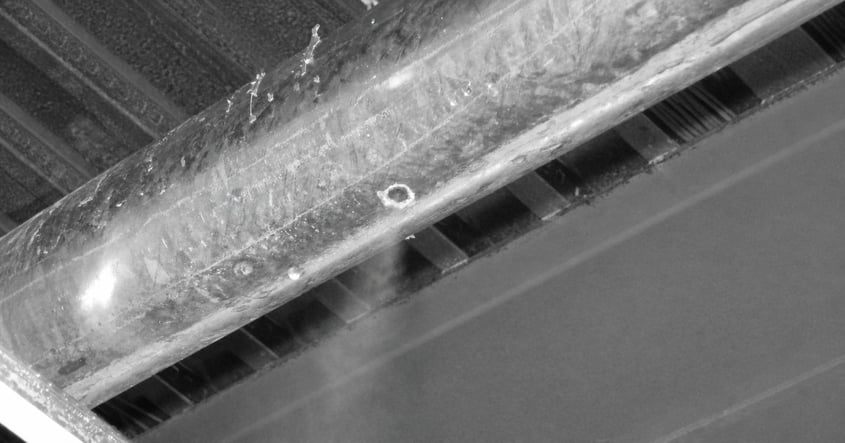
Over time, moisture and oxygen can create localized pitting. Because pitting can advance inside the pipe before it becomes visible from the outside, a system may appear serviceable while its remaining wall thickness is declining. In demanding environments, this process can contribute to pipe failure in as little as two to five years.
Nitrogen-based protection replaces oxygen-rich compressed air with a lower-corrosivity gas environment. The value is not limited to the generator itself. The system is designed to reduce the conditions that drive internal decay and to help preserve the piping investment over its intended service life.
Wet Pipe Systems
Wet systems are often perceived as simpler because the pipe is filled with water. However, trapped air at high points can create concentrated corrosion zones. These areas may become sources of pinhole leaks that are difficult to predict from external inspection alone.
A complete sales conversation should address how the system is filled, drained, tested, and maintained. Simple nitrogen purging and automatic air management can prevent or reduce trapped oxygen exposure, particularly where high-point conditions make localized corrosion and top-of-pipe leaks more likely.
The Total Cost of Ownership Fallacy
The apparent savings from a standard compressor or untreated fill can disappear quickly when the full ownership period is considered. A lower initial price does not account for the cost of emergency response, replacement sections, after-hours labor, impaired operations, investigation, cleanup, or a full retrofit.
A TCO model makes the comparison visible. It should include the protection investment, expected maintenance requirements, probable failure scenarios, replacement timing, and the financial impact of downtime. The model does not need to predict every event. It needs to show how a modest upfront difference can compare with a much larger range of downstream exposure.
Quantifying Hidden Operational Risks
Internal corrosion affects more than pipe appearance. Accumulated scale can increase friction inside the piping network, contribute to tuberculation and leaks, interfere with water movement, and create obstruction concerns. A leak can damage inventory, equipment, finished spaces, or production areas. An impairment can also require coordination across facilities, safety, operations, and insurance stakeholders.
The most persuasive business case translates each technical risk into an operational consequence:
- Pipe replacement becomes unplanned capital expenditure.
- Emergency service becomes premium labor and management time.
- Reduced flow becomes a fire protection performance concern.
- Facility impairment becomes lost production, delayed fulfillment, or restricted occupancy.
- Repeated claims or unresolved risk becomes an insurance and asset-management issue.
 Reframing the Sales Conversation: Moving Beyond the Initial Quote
The Price-versus-Value Trap
Price objections become more likely when nitrogen technology appears as a standalone equipment line. The buyer sees an added generator, additional controls, or more installation work without seeing the financial exposure those components are intended to reduce.
The solution is to connect the recommendation to a defined risk. Start with the condition of the system, the owner’s operating requirements, and the potential cost of failure. Then show how the proposed corrosion strategy addresses that exposure.
A useful sequence is:
- Establish the system’s corrosion conditions.
- Identify the business impact of a leak, impairment, or replacement.
- Quantify the likely cost categories over the ownership period.
- Compare proactive protection with reactive response.
- Present the ECS solution as the mechanism that supports the desired outcome.
Lead with Total Cost of Ownership
A strong presentation should show more than a first-year price. Build scenarios for 10, 15, and 20 years, using assumptions the customer can understand and challenge.
The model may include:
| Cost category | Reactive approach | Proactive corrosion strategy |
| Initial investment | Lower equipment cost, with corrosion exposure remaining | Added protection investment designed to reduce oxygen-driven decay |
| Maintenance events | Greater potential for emergency repairs and repeated service calls | More predictable maintenance planning and condition monitoring |
| Piping replacement | Higher risk of unplanned replacement as degradation progresses | Opportunity to preserve existing piping and extend useful life |
| Business disruption | Potential shutdowns, access constraints, cleanup, and operational delays | Reduced likelihood of corrosion-related interruptions |
| Risk and insurance | Greater exposure to loss-prevention concerns and claim severity | Stronger documentation of proactive risk management |
The goal is not to promise that corrosion control eliminates every future cost. The goal is to show that the buyer is choosing between two risk profiles, not simply between two equipment prices.
Target the Right Decision-Maker
Field technicians and project managers may evaluate installation practicality, maintenance access, and immediate budget. Those considerations matter, but they are not the only criteria.
Building owners, CFOs, risk managers, and facility executives are more likely to focus on asset longevity, business continuity, capital planning, and loss exposure. Tailor the value proposition accordingly:
- For the owner: protect the value and reliability of the existing fire protection asset.
- For finance: replace unpredictable emergency spending with a planned investment.
- For risk management: reduce the likelihood and severity of corrosion-related loss.
- For operations: reduce the chance that a sprinkler impairment disrupts the business.
- For engineering: apply a system-specific strategy supported by testing and measurable conditions.
 The Business Case: Translating Corrosion Science into Financial ROI
Use Evidence to Show Lifespan Value
The strongest ROI case combines corrosion science with evidence from the customer’s system or comparable installations. Inspection images, pipe samples, wall-thickness measurements, failure histories, and maintenance records can demonstrate that internal conditions deserve attention before a leak makes the risk visible.
Where validated field data supports it, show how oxygen removal can extend dry-system piping life by as much as five times compared with an oxygen-rich operating environment. For wet systems, show how reducing trapped oxygen can help prevent high-point leaks and preserve the value of existing piping.
The message should remain precise: the expected result depends on system design, operating conditions, existing corrosion, and installation quality. That precision builds credibility rather than weakening the sale.
Calculate Real Payback Periods
A payback discussion should compare the protection investment with specific avoided costs. For dry and preaction systems, the model can compare the one-time generator and installation cost with the potential multi-hundred-thousand-dollar expense of a full pipe retrofit, including access, labor, impairment, and facility shutdown. In high-consequence environments, a single emergency project can exceed $100,000 before the indirect costs are fully counted.
For wet systems, the model can focus on the cost of recurring high-point leaks, emergency response, water damage, replacement sections, and the disruption associated with taking portions of the system out of service.
Avoid presenting a generic payback number without explaining the assumptions. A transparent model gives the buyer a way to validate the analysis with their own maintenance records, labor rates, replacement costs, and downtime estimates.
Build a Total Cost of Risk Model
A simple ROI model can combine four categories of value:
- Avoided or deferred pipe replacement.
- Reduced emergency service and remediation costs.
- Zero corrosion-related business disruption in the modeled scenario when protection prevents impairments.
- Lower exposure to insurance and loss-prevention concerns.
These categories help different stakeholders see the same investment through their own priorities. They also give the sales team a repeatable structure for discussing value without relying on discounting.
End the Reactive Repair Cycle
Temporary clamps and isolated pipe replacements may restore service, but they do not necessarily address the condition that caused the failure. When the underlying oxygen exposure remains unchanged, another repair can become the beginning of another expense cycle.
A root-cause conversation changes the commercial outcome. Instead of asking only how to fix the latest leak, ask why corrosion is occurring, how widespread the condition may be, and what intervention can reduce the chance of recurrence. That shift positions the contractor or engineer as a long-term advisor rather than a provider of emergency labor.